

Pre-Print Study by The Health Sciences Research Education Center & The Assertive Kids Foundation
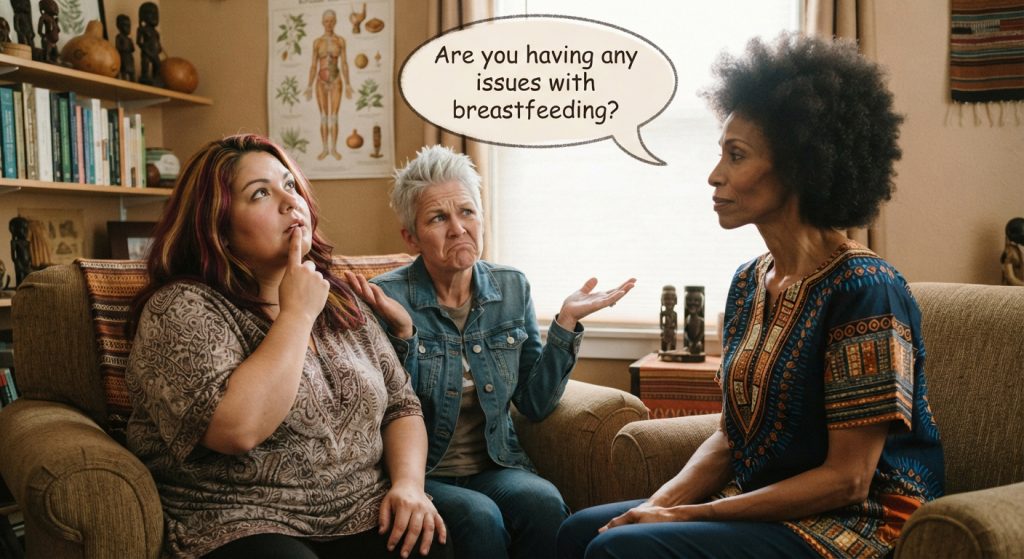
The Performance of Ease: Why Asking About “Breastfeeding Issues” Fails New Mothers
In the architecture of contemporary postpartum care, standard clinical intake often relies on a ubiquitous, seemingly benign inquiry: “Are you experiencing any breastfeeding issues?” Poised as a neutral diagnostic tool, this question is intended to open a clear channel between practitioner and patient. Yet, in practice, it frequently functions as a profound paradox. Clinicians encounter a pervasive dissonance where a mother will calmly assert that everything is entirely fine, only to immediately and organically enumerate a cascade of acute physical, mechanical, and emotional hurdles—ranging from agonizing nipple trauma and sleep deprivation to deep infant-feeding anxieties—within minutes of the initial exchange.
To understand this disconnect, we must examine why reductionist frameworks of “good” or “bad” collapse under the weight of lived reality, and why asking mothers to evaluate their lactation journey through the binary lens of “issues” sets up an institutional trap. Drawing on feminist discourse surrounding the medicalization of the female body, psychological defense mechanisms, sociological achievement culture, and the anthropological eradication of the village, this dynamic reveals how traditional inquiries force parents into a defensive, performance-based posture. When lactation is framed as a test to be passed or failed rather than an embodied, relational process, the inherent joy of nourishment is systematically eroded, replaced by chronic anticipatory anxiety. By moving away from judgmental evaluations and instead anchoring professional dialogue in descriptive inquiries of the what and the how, we can dismantle these performative barriers, restore maternal autonomy, and redefine how healthcare systems support the postpartum transition.

The Architecture of Isolation: Psychological Defense and the Myth of the Autonomous Producer
The friction between a mother’s reflexive assurance that everything is “fine” and her simultaneous enumeration of severe physical and emotional distress is not an accidental communication gap; it is a predictable psychological and sociological response to an institutional trap. From a psychological standpoint, asking a postpartum mother if she has “issues” immediately activates a defensive posture. In a hyper-vulnerable state, she filters the question through an internal grading rubric of competence and maternal worth. Admitting to a struggle feels dangerously close to admitting to a biological or personal failure. Saying “fine” functions as an ego-protective shield designed to preserve her fragile sense of self.
This psychological defense is heavily reinforced by sociological and cultural pressures. We operate within a neoliberal achievement culture that demands hyper-independence, turning the human body into a private enterprise responsible for its own metrics of optimization and output. Within this framework, lactation is subtly reframed as a corporate productivity project where the mother acts as the sole manager of a biological manufacturing unit.
Scholars examining these dynamics have documented how institutional structures fail postpartum parents through several key frameworks:
- Masking Vulnerabilities in Clinical Interactions: Research by Jordan (1997) demonstrates how first-time parents actively suppress their true physical and emotional vulnerabilities during clinical encounters to project a polished facade of successful adjustment. When practitioners utilize closed intake questions, it directly correlates with suppressed disclosures, forcing mothers to hide behind a veil of compliance rather than seeking the support they desperately need.
- The Medicalization of Natural Physiology: In the work of Dykes (2005), the institutionalized reliance on biomedical language is shown to strip the rich cultural and emotional meaning away from lactation. This reductionist approach turns normal physiological variations and natural learning curves into clinical “pathologies” or “issues” that invite judgment, transforming an embodied human experience into a condition to be managed.
- Intensive Motherhood and Moral Imperatives: Faircloth (2010) analyzes how intensive parenting ideologies frame breastfeeding as an absolute moral imperative. This cultural expectation locks mothers into rigid, defensive postures where admitting to a physical struggle or a latch difficulty feels equivalent to a failure of moral character and maternal devotion.
- The Failure of Reductionist Screening: Hall & Carty (1993) highlight how standard, reductionist screening questions completely fail to capture the complex, lived reality of postpartum recovery. Because these inquiries lack narrative depth, they systematically force mothers to minimize deep-seated physical and emotional concerns to satisfy perceived institutional expectations.
- The Bidirectional Loop of Lactation Anxiety: Borra, Iacovou, & Sevilla (2015) examine the intricate relationship between lactation anxiety, clinical framing, and maternal distress. Their findings show that performance pressures and closed clinical screening directly exacerbate psychological distress, turning a transitional bonding period into a chronic source of anxiety.
When clinical systems demand binary compliance, they ignore these well-documented realities. As one mother candidly shared from her own experience:
“I’m literally screaming and crying in pain while breastfeeding… My nipples were cracked and bleeding too, skin peeling off, pain that made me cry before she even latched. No amount of adjusting our positions or her latch helped… I thought maybe breast feeding was just uncomfortable and I should suck it up.”
By framing early feeding through an industrial lens of potential “issues,” the system abandons the mother, replacing the innate joy of nourishment with the chronic anxiety of a high-stakes performance review.

The Missing Village: Anthropological Realities and the Trap of the Clinical Interrogation
To fully grasp why a simple question about “issues” causes such profound psychological whiplash, we must also examine the anthropological and cultural vacuum in which contemporary parents find themselves. Human lactation never evolved to be managed in isolated domestic units where a mother evaluates her milk supply, infant weight trajectories, and physical recovery entirely on her own. Historically, the steep learning curve of early feeding was embedded within nested layers of an intergenerational village. Mothers were surrounded by experienced women who shared the physical labor, normalized the raw and exhausting transition of nursing, and provided an immediate safety net when friction arose.
When modern healthcare systems strip away this communal scaffolding and replace it with sterile, isolated clinical interactions, the entire dynamic shifts. Asking an isolated mother if she has “issues” in a brief intake encounter transforms a normal, shared biological hurdle into an individual emergency. Without a village to contextualize the messy reality of healing, she internalizes every struggle as personal proof that her environment is failing because she is failing.
This institutional blindness was powerfully illustrated by another mother recounting her early pediatric check-in:
“My breastfeeding journey started similarly… I thought it was going pretty well: no pain, he seemed to like eating, and was more or less on schedule with feedings. I felt really capable… [At the pediatrician appointment] our little guy had lost quite a bit of weight, wasn’t having enough wet diapers, and was extremely fussy. Our pediatrician told us to start supplementing immediately… I was distraught. I was starving my baby and I didn’t even know it!”
This testimony captures the profound emotional betrayal of reductionist clinical questioning. The mother walked in feeling confident because she had survived the private isolation of her home, only to be ambushed by a binary screening process that offered no narrative bridge between her lived reality and clinical metrics. When practitioners rely on closed, judgmental evaluations of “good” or “bad,” they reinforce the exact achievement culture that isolates parents in the first place. Reclaiming postpartum care requires acknowledging these deep anthropological and cultural roots, allowing us to pivot away from clinical inspection and toward genuine, communal support.

Beyond the Interrogation: Redefining Clinical Communication Through the “What” and the “How”
When we trace the arc from the clinical intake room to the isolated reality of the modern home, the necessity for a fundamental paradigm shift becomes undeniable. Asking a postpartum mother if she is experiencing “breastfeeding issues” is not merely an ineffective screening tool; it is an active participant in an oppressive cultural machinery. Grounded in the intersecting frameworks of feminist discourse, psychological defense, sociological achievement culture, and anthropological isolation, this question forces her into a defensive posture, treats her body as an industrial unit, and replaces the innate, biological joy of nourishment with the chronic anxiety of a high-stakes performance review.
The authentic voices echoing across public forums—where mothers describe enduring agonizing pain in silence while declaring that everything is “going great,” or wrestling with silent under-supply while feeling utterly capable—prove that the traditional framework is broken. When healthcare systems rely on binary, reductionist categorizations of “good” or “bad,” they compel women to mask their struggles to preserve their perceived moral and maternal worth, validating what scholars like Jordan (1997), Dykes (2005), Faircloth (2010), Hall & Carty (1993), and Borra, Iacovou, & Sevilla (2015) have long demonstrated about the suppressive nature of clinical surveillance.
To dismantle this trap, lactation professionals and medical practitioners must abandon the grading rubric entirely. We must move away from closed diagnostic interrogations and instead anchor our clinical dialogue in the descriptive what and how:
- Shifting from judgment to mechanics: Asking “What does your baby’s latch feel like in the first thirty seconds?” replaces a pass/fail audit with a tangible, physical puzzle that can be solved together.
- Shifting from compliance to context: Inquiring “How are you managing your rest and positioning during night feeds?” acknowledges the holistic, ecological reality of the postpartum body rather than reducing it to a malfunctioning machine.

By transforming the clinical encounter from an institutional inspection into a collaborative space, we dismantle the myth of the isolated, hyper-optimized producer. We validate human vulnerability, honor maternal autonomy, and restore the lost village within the four walls of the practice. When we stop asking mothers if they have “issues” and start asking them what their actual, lived experience looks like, we finally give them permission to drop their armor—ensuring that healthcare becomes a true sanctuary of support, healing, and connection.

Conclusion: Toward an Emancipatory Practice in Lactation Care
Ultimately, redefining how we approach the postpartum dyad requires a radical departure from the clinical status quo. The question “Are you experiencing any breastfeeding issues?” remains a relic of a medicalized, patriarchal framework that prioritizes institutional efficiency over human well-being. By examining how this inquiry triggers a defensive, performance-based posture through psychological self-preservation, sociological achievement culture, anthropological isolation, and feminist critiques of the industrialized body, we see that the burden of modern motherhood is deeply structural. When we strip away the neoliberal myth of the autonomous producer and acknowledge the absence of the communal village, it becomes clear why mothers so often default to saying “fine” while quietly drowning in the realities of early lactation.
As lactation professionals and healthcare practitioners, our responsibility is to break this cycle of isolation and compliance, and even encourage other health care professionals we work with to do the same. By consciously discarding reductionist evaluations of “good” or “bad” and replacing them with open, descriptive inquiries into the what and the how, we transform our clinical spaces, as do our peers serving our medical clients. We move away from policing the female body and toward walking beside the parent, and again, encourage other medical professionals to consider this as well. In doing so, we strip away the fear, dismantle the achievement culture, and return lactation to what it was always meant to be: an embodied, supported, and fundamentally joyful human relationship, and form the potential for larger supportive community as a natural consequence.

References
- Borra, C., Iacovou, M., & Sevilla, A. (2015). New Evidence on Breastfeeding and Postpartum Depression. Maternal and Child Health Journal, 19(5), 897–907.
- Dykes, F. (2005). Breastfeeding: Good Practice in Nursing and Midwifery. Books for Midwives / Elsevier.
- Faircloth, C. (2010). Milky Power: The moral economy of breastfeeding and intensive parenting. International Journal of Sociology of the Family, 36(2), 159–176.
- Hall, W. A., & Carty, E. M. (1993). First-time mothers’ experiences with “placental shifting” and postpartum support. Health Care for Women International, 14(2), 139–150.
- Jordan, P. L. (1997). First-time fathers’ and mothers’ initial experiences with newborn care. Nursing Research, 46(5), 272–279.
