
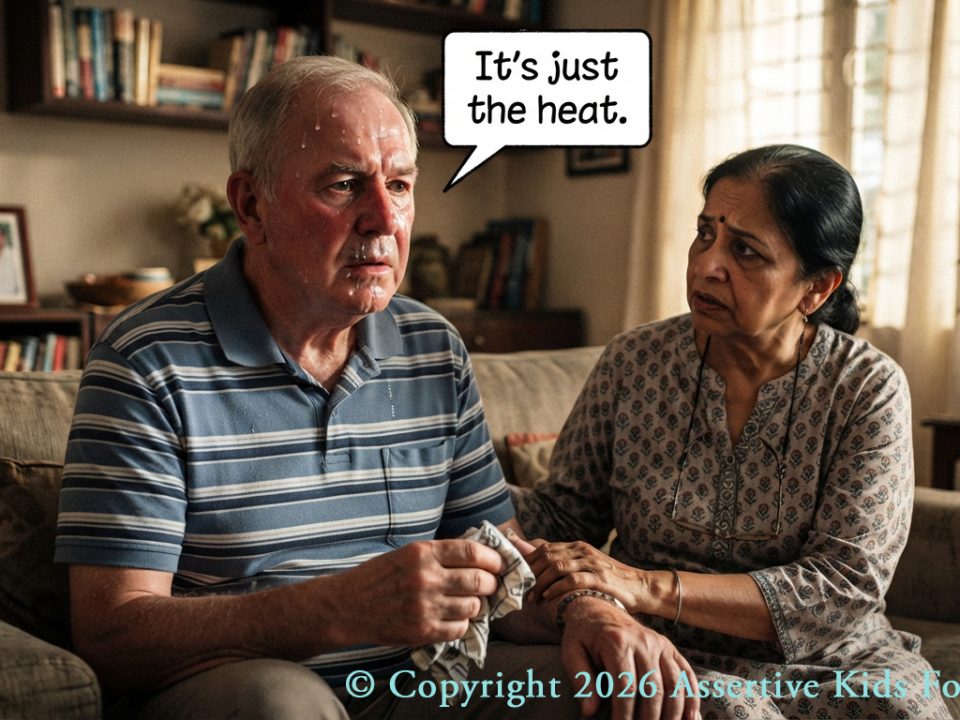
The Neglected Sign: A Critical Survey of Cardiac Insufficiency, Autonomic Dysregulation, and the Clinical Culture of Diaphoresis Dismissal
The Neglected Sign: A Critical Survey of Cardiac Insufficiency, Autonomic Dysregulation, and the Clinical Culture of Diaphoresis Dismissal
PRE-PRINT STUDY
Authors: THE HEALTH SCIENCES RESEARCH EDUCATION CENTER & THE ASSERTIVE KIDS FOUNDATION
Abstract
In clinical cardiology and general practice, diaphoresis is frequently relegated to a secondary, non-specific symptom—often dismissed as benign anxiety, thermal stress, or a vague consequence of vagal activation. However, a growing body of open-access literature (indexed across DOAJ and PubMed Central) posits that regional hyperhidrosis and paroxysmal sweat crises are active, quantifiable expressions of cardiorenal maladaptation. This survey evaluates the physiological mechanisms linking low cardiac output to sudomotor activation, analyzes the historical roots of clinical oversight, examines the systemic masking of symptoms across all populations, and specifically highlights how baroreflex senescence in the geriatric cohort turns craniofacial hyperhidrosis into an essential diagnostic proxy.
1. Introduction: The Cultural Epistemology of Diagnostic Neglect
Traditional medical pedagogy trains practitioners to search for canonical structural milestones of heart failure (HF): peripheral pitting edema, jugular venous distension, orthopnea, and basal crackles. Consequently, subtle somatic signals that do not fit neatly into hemodynamic imaging or biomarker panels (such as BNP) are systematically marginalized.
As highlighted by Slavich et al. (2021) in their foundational review “Hyperhidrosis: The Neglected Sign in Heart Failure Patients,” profuse sweating reported during outpatient visits or emergency admissions is rarely investigated beyond a superficial level. This cultural blind spot stems from a strict compartmentalization of medical specialties:
- Dermatology claims hyperhidrosis as a localized, primary functional disorder of the eccrine glands.
- Cardiology restricts autonomic assessment primarily to rhythm strips or gross orthostatic changes.
When these silos collide, a patient presenting with paroxysmal upper-trunk or craniofacial sweating in the absence of manifest peripheral edema is frequently subjected to psychiatric or endocrinological workups, while their underlying myocardial strain goes unaddressed.
2. The Cardiorenal-Sudomotor Axis: Ductal Transport Kinetics and pH Biochemistry
To understand why diaphoresis accompanies failing myocardial performance without relying on clinical folklore, literature grounds the phenomenon in hard biophysics and cellular biochemistry across the two-stage model of eccrine function:
- The Primary Secretory Coil: Driven by cholinergic and adrenergic stimulation, the coiled portion produces an isotonic ultrafiltrate of plasma containing high levels of sodium (Na+), chloride (Cl−), potassium, lactate, and urea.
- The Reabsorptive Duct and Transport Saturation: Under states of cardiac insufficiency, reduced stroke volume triggers arterial baroreceptors, unleashing a flood of circulating catecholamines (epinephrine and norepinephrine) alongside up-regulated Renin-Angiotensin-Aldosterone System (RAAS) activity. While mineralocorticoids like aldosterone normally signal the duct to conserve sodium via channels like ENaC, the sheer velocity of neurogenic sudomotor throughput during acute paroxysmal surges overwhelms ductal reabsorption capacity. The resulting sweat dumps measurable quantities of electrolytes and water outward, functioning as an auxiliary escape valve for a congested vascular tree.
- Metabolic and pH Dynamics: Normal eccrine sweat is characteristically acidic (pH 4.0 to 6.8), maintained by lactic acid and proton exchanges. During periods of low cardiac output and peripheral vasoconstriction, cutaneous and systemic tissues experience micro-circulatory stagnation, shifting local metabolism toward anaerobic glycolysis. This elevates circulating and interstitial lactate levels, causing an abrupt paroxysmal sweat crisis to display transient perturbations in local skin surface pH and buffering capacity that mirror the systemic metabolic strain of the failing pump.
3. The Phenomenon of Masking: From General Populations to Unidentified Cases
The diagnostic oversight surrounding diaphoresis is severely compounded by the phenomenon of clinical masking, which occurs across broad patient demographics regardless of whether cardiac insufficiency has been formally diagnosed:
- In Unidentified and General Cohorts: Patients experiencing subclinical or early-stage myocardial maladaptation frequently experience episodic, drenching upper-body sweats long before classic fluid retention registers on a scale or manifests as pitting edema. Because these episodes are often intermittent and occur outside clinical settings, patients dismiss them as hot flashes, fitness artifacts, or stress, while primary care providers attribute them to autonomic reactivity or dermatologic hyperhidrosis.
- The Diagnostic Dead-End: Consequently, individuals with undiagnosed cardiac strain undergo extensive, circular workups for anxiety, menopause, or hyperthyroidism, leaving the primary neuro-cardiac driver completely masked behind an isolated dermatologic symptom.
4. The Geriatric Intersection: Autonomic Aging, Baroreflex Senescence, and Confounding Variables
While masking occurs across all age groups, the geriatric population represents the prime clinical intersection where this diagnostic oversight becomes dangerous due to specific physiological shifts and confounding variables:
- Baroreflex Senescence and Sympathetic Shift: Aging naturally induces a baseline state of increased sympathetic tone coupled with a blunted parasympathetic (vagal) response. When cardiac insufficiency layers over an aging autonomic nervous system, the system becomes “hair-trigger.” Age-related baroreflex senescence means minor shifts in volume or pressure result in explosive, localized sudomotor crises rather than smooth cardiovascular compensation.
- Masking of Classical Signs: In older adults, classic signs of heart failure (like severe peripheral edema or rapid weight gain) are frequently masked by age-related venous insufficiency, baseline immobility, or osteoarthritis. Craniofacial and upper-trunk hyperhidrosis thus becomes more prominent precisely because older bodies rely heavily on alternative neuro-endocrine adaptations when functional reserve drops.
- The Polypharmacy Confound: Geriatric evaluations must account for heavy polypharmacy. Older adults are frequently prescribed beta-blockers, ACE inhibitors, or diuretics, all of which alter thermoregulation and sweating pathways. A true academic framework must evaluate how drug-induced autonomic blockade interacts with these paroxysmal events.

5. Historical Precedents and Institutional Amnesia
The dismissal of diaphoresis represents a modern form of institutional amnesia. Mid-20th-century clinical literature frequently identified pre-decompensation sweat crises as critical warning signs.
- “Diaphoretic Asystole”: Classical clinical descriptions (referenced in historical cardiology texts and re-examined by Slavich et al.) documented discrete episodes of pallor, peripheral cooling, and heavy upper-body sweating lasting up to several hours preceding severe cardiorespiratory crises.
- The Cost of Technologic Reductionism: With the advent of high-resolution echocardiography and rapid lab assays, modern medicine grew overly reliant on static metrics. Subtle, dynamic physical semiology—such as episodic upper-trunk and craniofacial hyperhidrosis—was dropped from standard diagnostic intake because it lacked a simple digital score.
6. Modern Diagnostic Validation: Autonomic and Topographic Mapping
Recent open-access investigations (such as Peh et al., 2024) emphasize that sudden-onset or paroxysmal autonomic symptoms in aging or cardiovascularly compromised cohorts demand a diagnostic pivot.
- Shared Neural Pathways: Craniofacial and upper-trunk sweat glands share preganglionic sympathetic outflows (T1–T4) with the myocardium.
- HRV and Spectral Correlation: Quantitative autonomic studies demonstrate that patients presenting with these regional sweat phenotypes display severe suppression of parasympathetic buffering and fixed sympathetic dominance. Mapping these markers bridges the gap between subjective patient complaints and objective neuro-cardiac strain.
7. Conclusion: Elevating the Neglected Sign in Modern Clinical Practice
The persistent marginalization of diaphoresis as a mere cosmetic annoyance or non-specific nuisance represents a systemic failure of observational semiology within modern medical practice. Across both general and vulnerable geriatric cohorts, paroxysmal craniofacial and upper-trunk sweating functions as an external proxy for subclinical cardiorenal maladaptation, exposing the dangerous blind spots created by modern diagnostic reductionism. When clinicians rely exclusively on static structural imaging, advanced biomarkers, or overt peripheral edema, they systematically overlook the dynamic, neurogenic adaptations of an overstressed circulatory tree.
By recognizing the underlying biophysics—specifically arterial baroreflex failure, sympathetic-adrenergic overdrive, and ductal transport saturation during low-output states—the medical community can dismantle the artificial silos separating cardiology, neurology, and dermatology. Integrating sudomotor evaluation into routine cardiovascular assessments provides an accessible, early-warning indicator of autonomic strain long before structural decompensation occurs. Ultimately, restoring this neglected sign to its rightful place in clinical diagnostics bridges the gap between subjective patient presentation and objective physiological reality, offering a vital pathway toward earlier intervention and more comprehensive patient care.

References
- Brackenrich, J., & Fane, K. (2022). Hyperhidrosis. StatPearls Publishing. https://www.ncbi.nlm.nih.gov/books/NBK459227/
- Nawrocki, S., & Cha, J. (2019). Diagnosis and qualitative identification of hyperhidrosis. Shanghai Chest, 3, 35–35. https://doi.org/10.21037/shc.2019.06.04
- Peh, R., Yip, C. W., & Liew, Z. H. (2024). Acute hyperhidrosis: A clue to underlying autonomic dysfunction and a rare neurological disorder. Cureus, 16(12), e76387. https://doi.org/10.7759/cureus.76387
- Slavich, M., et al. (2021). Hyperhidrosis: The neglected sign in heart failure patients. American Journal of Cardiovascular Disease. PMC8611272.
Banner Image: Diaphoresis, or sweating, can be a sign of a deeper probelm, such as cardiac insufficiency. Image Credit – Assertive Kids Foundation
