
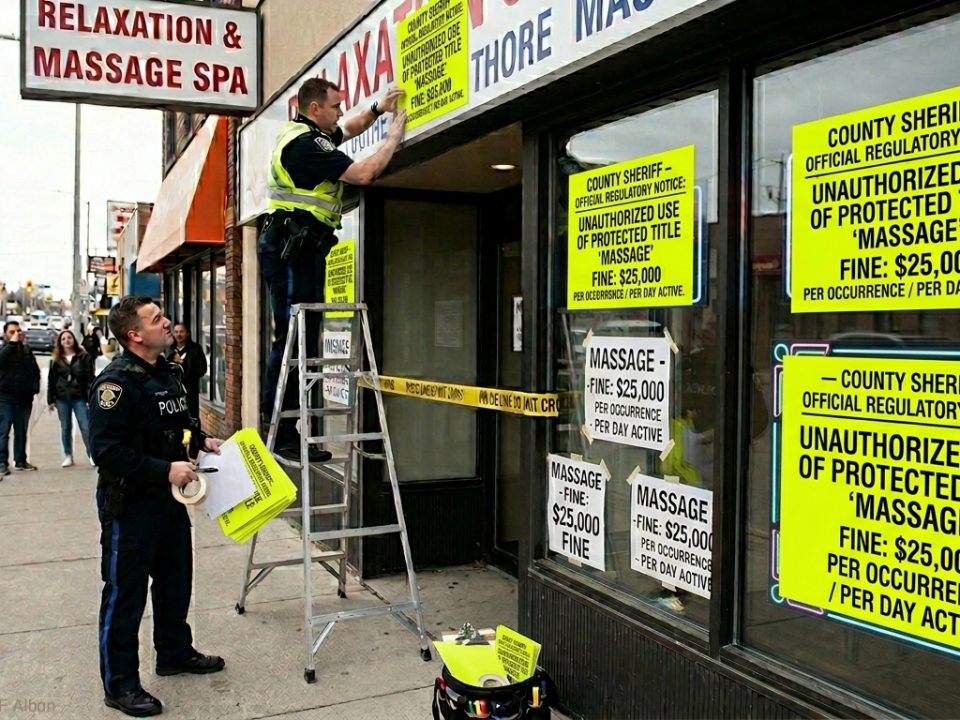
The State of New Jersey mandates a rigorous path to licensure for Massage and Bodywork Therapists under N.J.S.A. 45:11-53. This process requires hundreds of hours of accredited schooling, national board examinations (MBLEx), and continuous background monitoring. Despite this high bar for entry, a significant gap remains in how the State protects the professional titles it regulates. Currently, the terms “Massage” and “Massage Therapy” are frequently misappropriated by illicit entities to provide a legal veneer for unauthorized activities.
To preserve the integrity of the profession and the safety of the public—specifically vulnerable populations like postnatal mothers—the State must shift its focus toward the aggressive administrative prosecution of title infringement.
I. The Statistical Reality of Title Misuse
Data from the Federation of State Massage Therapy Boards (FSMTB) and the Polaris Project indicate that there are approximately 9,000+ establishments nationwide operating under the guise of “Massage” or “Spa” that are actually facilitating illicit services.
-
Consumer Demographics: These businesses are overwhelmingly frequented by male “Johns” (estimated at over 95% of the clientele), who utilize these storefronts specifically because the word “Massage” provides a perceived “safe” or “legal” entry point for illicit solicitation.
-
The Professional Crisis: This persistent conflation subjects legitimate, licensed practitioners—the majority of whom are female—to a “Double Vulnerability.” It forces them to operate in a climate where their professional title is used as a code word for unauthorized acts, leading to increased instances of harassment and a dilution of the clinical reputation of the field.
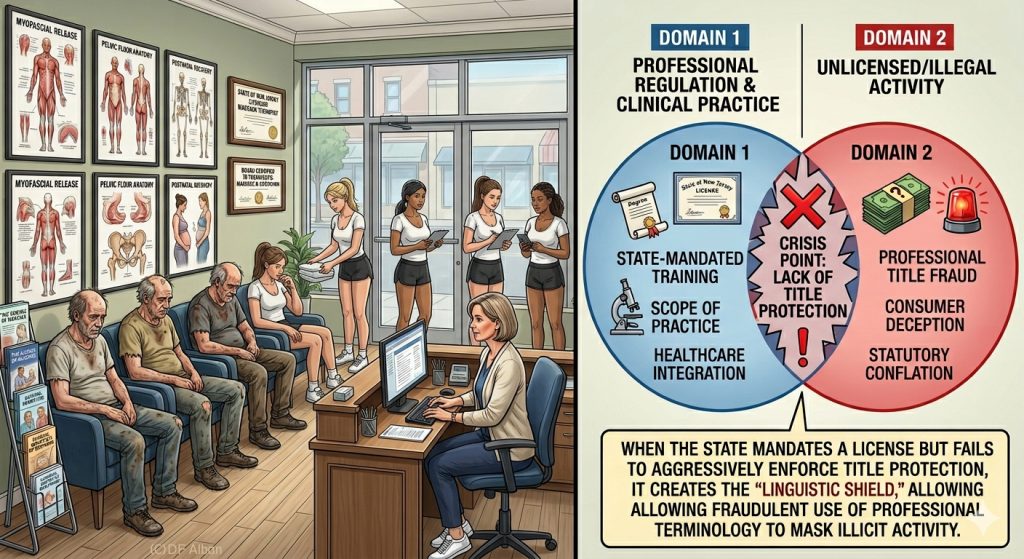
II. The “License-as-Shield” Tactic
A common tactic used by illicit storefronts is to employ a “manager of record” or a “straw-man” licensee. By having one individual with a valid New Jersey license on the paperwork, the business attempts to grant an entire facility the right to use the word “Massage” in its signage and marketing, even when the underlying activity is unauthorized.
The law must be clarified: A professional license is an individual credential, not a corporate umbrella. * The State’s “police power” ensures that the presence of a single license cannot be used to mask an operation that lacks 100% staff licensure. However, taht is not enough for LMTs.
-
The State should treat the misuse of the word “Massage” as Professional Fraud, separate from any other criminal charges.
III. Shifting the Burden: The Administrative Hammer
Currently, law enforcement is often tasked with complex “undercover” operations to prove a specific act occurred. The State should also utilize a Title Enforcement Model.
We are not looking to shutter businesses who may have a licensed therapist on-staff without a solid moral and professional core of values who says yes to an undercover cop propositioning. We want the law to differentiate between instances of this happening, and a business set up as a “front,” as it were, where every interaction between client and employee is sexual.
We do not want to punish business owners due to the fact that their employees are free-willed individual who may choose to do wrong.
-
The Trigger: When an establishment is caught facilitating illicit acts (solicitation or prostitution) through standard policing methods, a secondary Administrative Professional Fine should be triggered.
-
The Penalty: If the word “Massage,” “Massage Therapy,” or any state-recognized modality (such as Swedish or Shiatsu) appears on the signage, website, or marketing of an establishment where illicit acts occurred, the business should face immediate, crippling financial penalties for Title Infringement.
-
The Result: By making the misappropriation of the professional name an economic liability, the State removes the profit motive for using the “Massage” label as a shield.
IV. Conclusion: Protecting the Clinical Reputation
The New Jersey law was designed to protect the public. However, when the law fails to differentiate between “helpful, clinical touch” and “unauthorized touch,” it creates an inherent bias against legitimate practitioners. This is most evident in the postnatal community, where mothers seeking essential pelvic floor or myofascial recovery are often stigmatized by a legal framework that views their clinical needs through the lens of “vice” prevention.
The State has a duty to ensure that “Massage” means Massage. By strictly policing the professional name and imposing severe fines on those who hijack it for illicit purposes, New Jersey can finally separate the Clinical from the Criminal, allowing the profession to stand on its own merits as a vital branch of healthcare.
V. The Enforcement Spectrum: Trade Name vs. Physical Conduct
1. The “Administrative Audit” States (Title Protection)
These states have decoupled the “crime” from the “violation.” They don’t need to prove what happened behind a closed door; they only need to prove that the word “Massage” is on the sign without a valid license linked to it.
-
Florida (The Gold Standard for Fines):
-
The Mechanism: Florida’s Unlicensed Activity (ULA) program treats the misappropriation of the title as a financial liability from day one.
-
Trade Name Enforcement: The Board of Massage Therapy imposes an “Unlicensed Activity Fee” on every license ($5) to fund a dedicated strike force that audits storefronts and digital ads.
-
The Fine: Administrative fines frequently reach $10,000 per count. If a shop has “Massage” on the sign and “Massage” on their website, that’s two counts before an officer even walks in the door.
-
Texas (The “Emergency Order” Model):
The Mechanism: Under HB 3945 (2025/2026 Session), Texas has moved toward “Emergency Orders” that allow for the immediate freezing of a business license and location.
Colorado (The “Local Hammer” Model):
-
The Mechanism: HB26-1257 (March 2026) removed the $150 cap on administrative fees for local governments.
Trade Name Enforcement: Cities can now charge up to $500 per permit just to cover the cost of “Title Audits.” They use these fees to fund inspectors who verify that every modality listed on the menu (Shiatsu, Thai, etc.) is being performed by a licensee. If not, the “Trade Name” is revoked instantly.
2. New Jersey (The “Conflation” State)
NJ is currently “Lame” because it treats Title Protection as a secondary thought to criminal prosecution.
-
The Current Status (ACR112 – Feb 2026): The NJ Legislature recently directed the SCI to examine “human trafficking activity” at massage parlors.
-
The Flaw: By focusing on “activity,” NJ forces law enforcement into “behavioral stings.” Because the fine for simply using the word “Massage” is low or non-existent at the state level, there is no Economic Deterrent to stop a front company from just putting up a new sign the next day.
-
Trade Name Neglect: In NJ, you can often find a “Body Rub” parlor that uses the word “Massage” on its awning for years with zero administrative interference, because the Board of Massage and Bodywork lacks the “Sheriff’s Audit” power to interverene.

2 comments to “The Sanctity of the License: Protecting Therapeutic Massage from Professional Misrepresentation”
Dedicated To Postnatal Massage - April 2, 2026
These last two articles I think are the most important so far.
No one addresses the elephant in the room.
Therapeutic Massage is legit. And massage practitioners are treated like garbage.
It’s not really a lot they need to change in the laws.
Just a few tweaks here and there.
Elizabeth Pringle - April 2, 2026
While the institution of Massage Rules and Licensure in the various States can inarguably considered good, there is, of course, the issue of why the laws were initially framed. The laws in New Jersey need a few updates, but for the most part, the laws serve the LMTs, and public, quite well. Still, as the author has shown, gaps do exist.